YALE DAILY NEWS
By Ashley Fan
April 19, 2019

“Jook songs” — a wordplay on jook-sing, a Cantonese term for Chinese Americans — is the first song in the musical “Illegal” and a hybrid word that encapsulates what it means to be Chinese and American. Last summer, Skyler Chin ’19 was inspired to write a jook song of his own after reading poetry by Angel Island detainees. What was a single song has since bloomed into a fully fledged passion project, a 26-song musical about Chinese immigrants during the Chinese Exclusion Act.

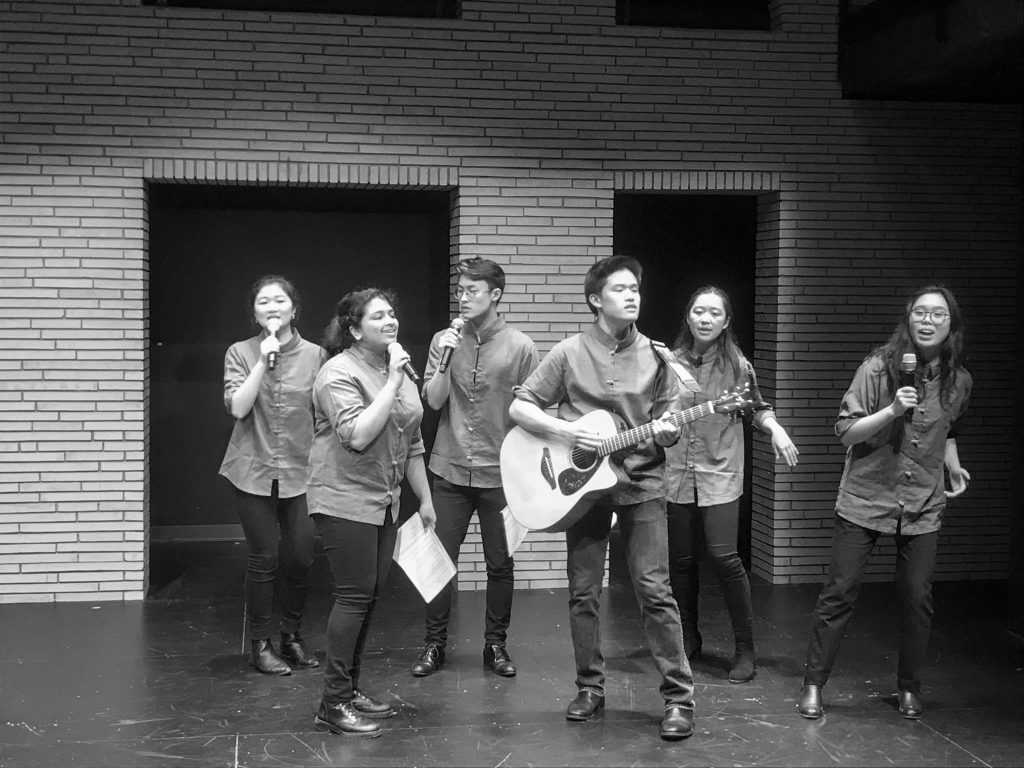
The musical “Illegal,” is directed by Olivia Facini ’19 and features a talented seven-person cast: Skyler Chin ’19, Sophia Dai ’20, Jason Kim ’21, Kathy Min ’21, Ananya Parthasarathy ’20, Jisu Sheen ’20 and Daniel Flesch ’19. It is a musical blending rap and spoken word, an original combination of genres that parallels the theme of dual identity throughout the play. “Illegal,” inspired by the real experiences of Chin’s grandparents, follows the immigration journey of several young Chinese immigrants attempting to enter San Francisco through Angel Island at the height of the Chinese Exclusion Act in 1923. The script is a balance of lighted-hearted humor and powerful emotion, and is always heavy with meaning: “Illegal” asks the timely and timeless question, ‘What does it take to be(come) American?’”

Illuminating Ellis Island’s lesser known West Coast counterpart, Angel Island, Chin tells history with his own twist. By writing and performing “Illegal,” Chin seeks to “carve out a space for untold stories and diverse performers to shine.” He takes Chinese stories into his own hands, blurring the line between history and fiction. Though the characters are fictitious, they were inspired by Chin’s family as well as the countless immigrants who were detained, dehumanized and deported at Angel Island, but who were never properly recorded in history.

Laced within the story are shocking details of experiences at Angel Island. The musical portrays the lengths that immigrants went through to pass inspections that were rigged against them: detainees endured violating physicals, “paper sons” who borrowed identities memorized coaching books filled with details of other people’s lives and the few women who attempted to immigrate were all assumed to be prostitutes. Each disturbing “fun fact” is delivered through enthusiastic song; the musical entertains nonstop, all while serving biting criticism of the inhumane methods employed at Angel Island to push out Chinese immigrants.

In addition to strong messages imparted in rhymes, the implications of this musical’s very existence cannot be lost. The entire conception of “Illegal,” from its inspiration by Chin’s grandparents in 1923 to its performance at Yale in 2019, is a unique product of the Asian diaspora, and in particular, the Chinese diaspora. Central elements of the musical, including its setting on the West Coast and references to the invention of boba, nod to both historical and contemporary Asian diasporic culture. Chin tells a story of Chinese immigrants in English — with rap and spoken word, no less. This crossover of cultures would not have been possible without decades of cultural development within the Asian diaspora.

Chin’s blending of Chinese and American identities in “Illegal” is remarkably bold. Common principles in Chinese culture, from filial piety to honor, both clash and mesh with American values of freedom and allegiance. The most complex character in the play, the Chinese-American translator for Angel Island inspections, experiences an identity crisis when confronted with the moral dilemma of his cruel job, and his split loyalties to his country and his people.

A goosebump-inducing scene near the end of the musical alludes to the poetry that inspired Chin to write “Illegal” — a Cantonese voice-over melds with the voices of the cast as they recite translated verses that real immigrants had carved onto the walls of Angel Island detainment centers, the weight of each word they spoke striking along with the beat of the drums. “Now the history is mine to write,” says Chin’s character, a line that seems to refer to his own writing of history in the form of the musical. As the program notes, “Illegal” may be your introduction to this history, but do not let this be the end of your exploration.”

Catch “Illegal” this weekend on Friday, April 19 at 8 pm or Saturday, April 20 at 2 pm or 8 pm.

Ashley Fan | ashley.fan@yale.edu

URL: https://yaledailynews.com/blog/2019/04/19/illegal-a-musical-reimagines-the-chinese-diaspora/
Print: PDF
TSAI Center for Innovative Thinking at Yale
November 28, 2018

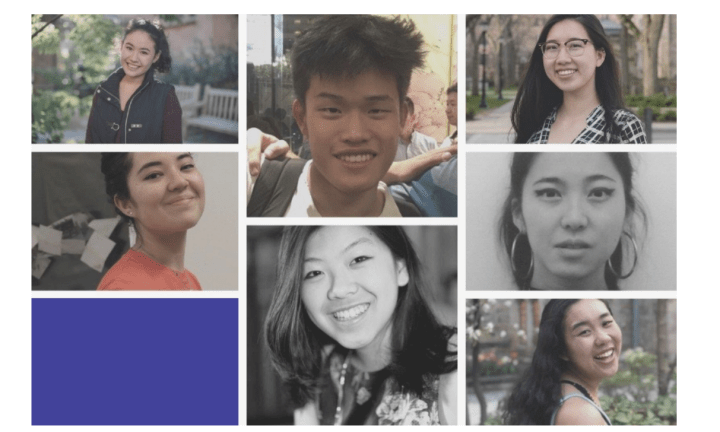
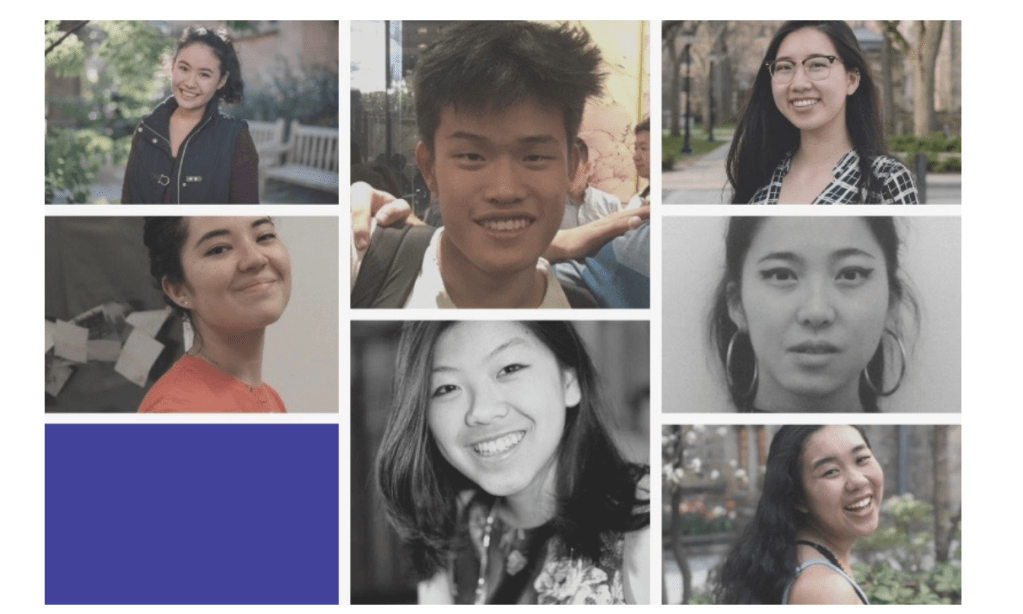
Student award winners.

From a lack of roles on mainstream television to the 25-year gap between The Joy Luck Club and this year’s Crazy Rich Asians (the most recent major movies to feature majority Asian American casts), Asian American representation in media and the arts continues to lag. Media studies show that Asian American experiences are often absent from screens, galleries, and theaters, or flattened to stereotypical, one-dimensional portrayals. This fall, Tsai CITY and the Asian American Cultural Center at Yale (AACC) teamed up to encourage Yale students to apply their creativity to addressing this issue. The Arts & Media Innovation Awards, comprised of five $500 grants, aim to encourage art and multi-media explorations of Asian American identity.

“Students have often expressed their frustration with the under/misrepresentation of Asian Americans in mainstream media, not feeling like they always had the means to tell their story,” says AACC director Joliana Yee, who conceptualized the program. “In launching this award program with Tsai CITY, it is my hope that our Asian American students will be empowered to use their voice to amplify the often untold and unseen lived experiences of the Asian American community.” The award program’s call for projects this fall was broad, inviting proposals for art pieces, musical compositions, films, podcasts, poetry, and other creative projects. Regardless of medium, applicants were challenged to broaden the representation of Asian American experiences. The project brief asked students to outline how their project would be innovative — defined as “exploring, understanding, and challenging existing systems so as to
imagine what could be” — as well as how it would center underrepresented voices and be accessible to a wide audience.

Five projects, offering a variety of lenses on Asian American identity, were selected in a process led by a panel of alumni: Nancy Yao Maasbach (SOM ’99), president of the Museum of Chinese in America; Art Priromprintr (YSD ’11), Manager of Dance Programming at The Kennedy Center; Ellen Su (YC ’13), co-founder and CEO of Wellinks and a CITY mentor-inresidence; and Kevin Winston (YC ’91), CEO of Digital LA and founder and president of Yale in Hollywood. Through music, theater, film, photography, and audio/visual installation, students will collectively explore immigration and assimilation, mixed-race identity, family heritage, food, and more.

Over the next few months, students will work with mentors from CITY’s network, along with staff at both CITY and the AACC, as they develop their ideas. The five projects will debut as part of Pan Asian American Heritage Month in March 2019. Meet the project teams:

Asian-American Representation Through Songwriting
Emily Li (YC), Caroline Ho (YC)
These students plan to write and record an EP of original songs focusing on Chinese
immigrant stories and experiences, with at least one song in a mix of Chinese and English. Li is a singer-songwriter and Ho is a pianist-songwriter; they plan to bring these skills together to share their families’ stories, with a goal of shedding light on underrepresented experiences and starting conversations. “In writing music about these stories,” they say, “we aim to raise awareness to the experiences of Asian immigrants, while celebrating their determination, struggle, and culture.”

Asian-ish Photo Project
Molly Ono (YC), Mariko Rooks (YC)
Ono and Rooks will create a photo campaign centered around examining the experience of mixed Asian students on Yale’s campus. They envision a combination of group and individual photos that showcase the visual diversity of the mixed population on campus, while providing personal stories and narratives to give voice to the simultaneous uniquenesses and the universality of the mixed experience. They note, “Much of the mixed experience centers around the discomfort and lack of belonging that stems from physical ambiguity and the resulting desires of others to racially categorize mixed individuals (i.e., asking ‘What are you?’ in the middle of a supermarket). By reclaiming our image though photography and proudly displaying
it in Asian American spaces, we redefine what it means to ‘look Asian.’”

Illegal: A New Musical
Skyler Chin (YC)
Composed by Skyler Chin, this original musical blending rap, rock, and spoken word poetry is inspired by the true experiences of Skyler’s grandparents. With content based on historical documents, “Illegal” traces the immigration journeys of several young people from China to the United States in 1923, when the US enforced its Chinese Exclusion Act by separating families at the border and imprisoning them on Angel Island for interrogations. “Chinese Exclusion hugely impacted American immigration history, yet it is rarely covered in American history education,” says Chin. “My musical tells an often-neglected narrative and celebrates the voices of people that were both actively silenced in history and forgotten in the present.”

Ping Pong Social Club Film
Liyan Zhao (School of Art)
This film explores the nuances of immigration, citizenship, and connections to place through two parallel storylines: a story about Zhao’s father, who has hosted a weekly ping pong club for almost a decade, and a diaristic account of Zhao’s own recent US naturalization and, subsequently, her first trip to China as a foreign national. The film’s experimental structure will allow it to expand beyond a singular experience of immigration. Zhao explains, “This film tells my personal story but also represents experiences shared by many other Asian Americans and immigrants to this country. It is a multi-generational and multi-cultural tale that probes tensions between father and daughter, America and China, assimilation and alienation.”

Snack
Annie Cheng (YC)
“Snack” is a multi-media audio and visual installation project. Cheng plans to interview Asian Americans about edible touchstones of their childhoods, from homecooked meals to packed school lunches, exploring how identity can be understood through food. As the project’s culmination, she will present an edible exhibition, bringing together photos and interview material with some of the foods discussed in the interview series. “Asian food has experienced an unusual transition in recent years,” Cheng says. “When I was a kid, it was a ‘gross’ thing that was embarrassing to bring to school; now, it’s become a gentrified and exoticized new trend to try. My goal is to celebrate it authentically and respectfully, contextualizing food origins as a connection to identity.”

Mark your calendars for March 2019, when these projects will debut — and in the meantime, look out for stories from CITY on the process behind the creation of these projects. Learn more about CITY here and get to know the AACC here .


URL: city.yale.edu/blog/2018/11/28/city-and-aacc-announce-arts-amp-media-innovation-award-winners
Print: PDF